
Human papillomavirus (HPV) remains the most common sexually transmitted infection worldwide as of 2025. Yet despite the growing role of social media in promoting public awareness of health concerns, many young Filipino adults continue to have limited awareness of HPV vaccine availability in the Philippines and perceive discussions about HPV to be scarce.
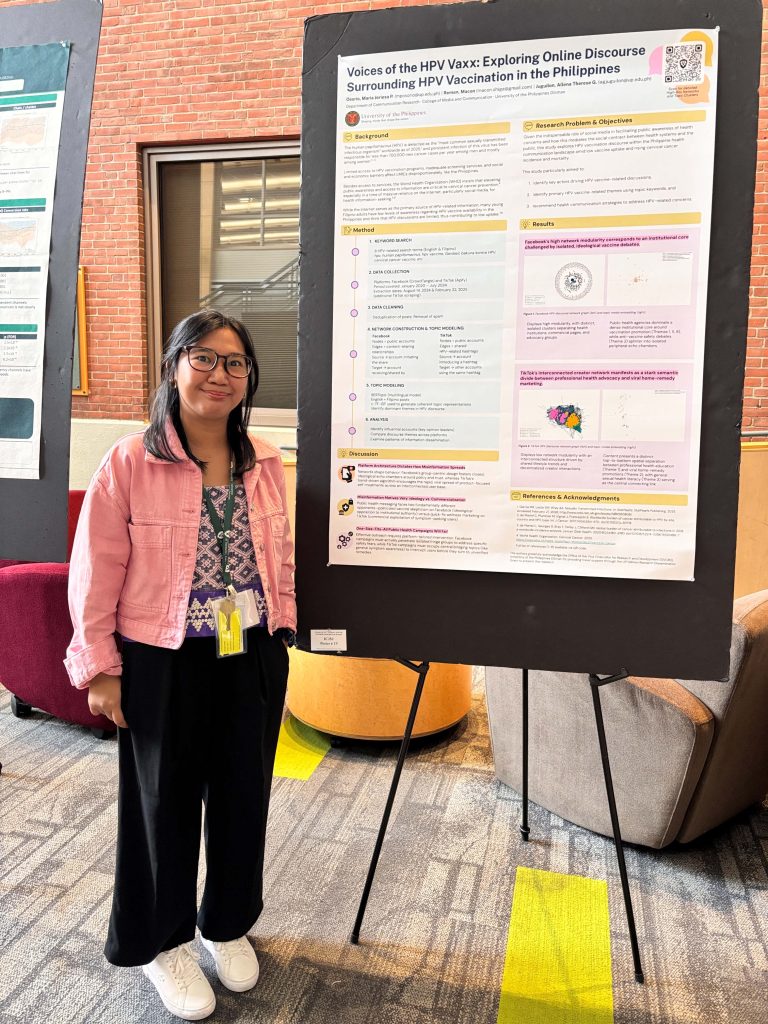
This was central to the inquiry of “Voices of the HPV Vaxx: Exploring Online Discourse Surrounding HPV Vaccination in the Philippines,” a co-authored paper by Asst. Prof. Maria Jeriesa Osorio, MA with CRes students Macon Reman and Allena Therese Juguilon.
The study, developed under the Department of Communication Research’s Philippine Media Monitoring (PMM) Laboratory or Subaybay, was presented by Asst. Prof. Osorio, MA at the 12th International Conference on Computational Social Science (IC2S2).
Using network analysis and topic modelling of HPV-related discussions on Facebook and TikTok, the study identified key actors driving HPV vaccine-related discussions, primary HPV vaccine-related themes, and recommended health communication strategies to address HPV-related concerns. “We employed the BERTopic model, which uses a class-based term frequency-inverse document frequency (c-TF-IDF) algorithm to evaluate the importance of terms within a cluster, reduce the number of topics, and improve word coherence among topics to create term representations,” Asst. Prof. Osorio explained.
Beyond identifying discussion patterns, the study revealed broader challenges in the Philippine HPV communication landscape. While information about HPV vaccination is present across social media platforms, messaging often remains fragmented, limiting opportunities for sustained public engagement and awareness. “To optimize public health outreach, it is imperative to foster cross-platform and cross-cluster partnerships while standardizing evidence-based content across all digital and community channels”, the researchers emphasized.
The paper’s presentation at IC2S2 reflects the department’s continuing research and creative efforts through SURI—particularly the Philippine Media Monitoring Laboratory (Subaybay)—to examine contemporary communication issues through computational approaches, demonstrating how digital trace data can provide valuable insights into public discourse and emerging social concerns in the Philippines, such as health communication.
An interactive poster of the study may be accessed here: https://maconreman.github.io/hpv-network/
The 12th International Conference on Computational Social Science was hosted by the Vermont Complex Systems Institute at the University of Vermont in Burlington, Vermont, and was held 28-31 July 2026. The Conference promotes the intersection of social and computational science, committed to understanding the social world through large-scale data and computation.
/MANST

Leave a Reply